Whisky and Words Number 25: Springbank 10

The Springbank website crawler hint says “Springbank is a unique Campbelltown distillery” and this is no mere marketing. Read on.

I’ve really looked forward to trying this malt. I had to afford it first, it’s pricey ($78 in Oregon). But as “the only Scottish distillery to complete 100% of the production process on site” (link) and their claim that Springbank 10 is distilled ‘two and a half times’ — I had to know, how much magic resulted?
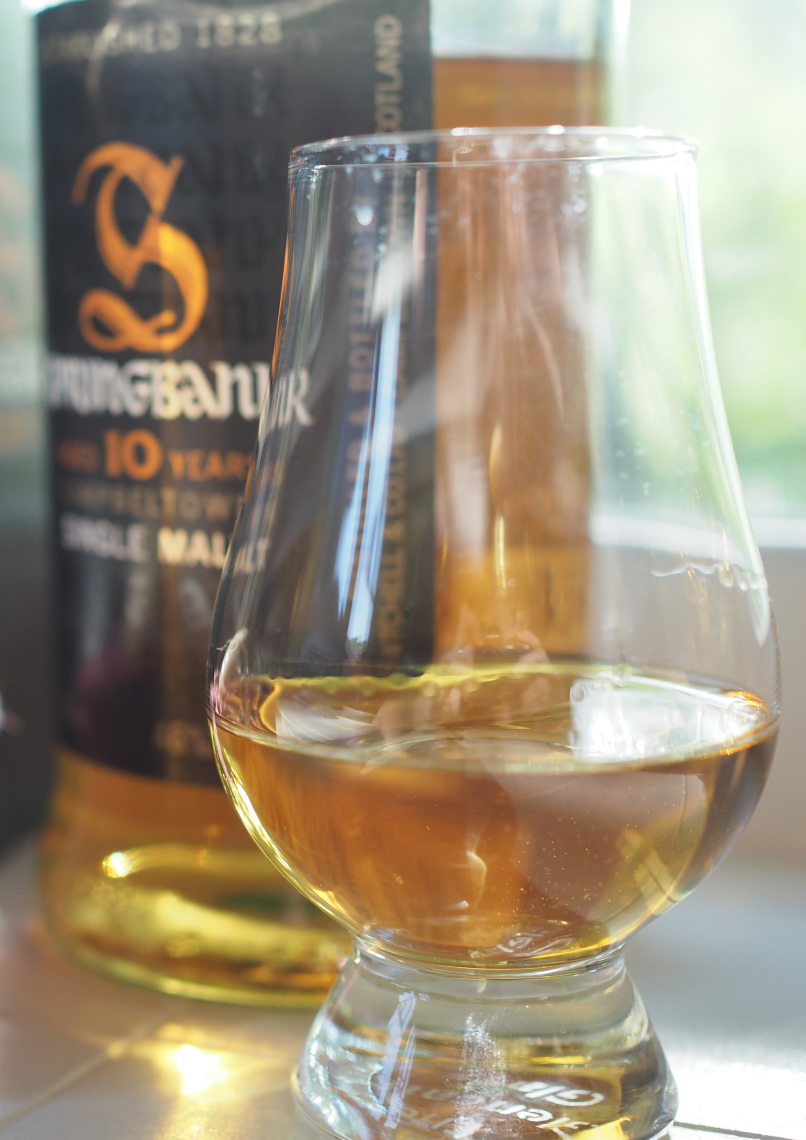
Honest coloring

I’ve had a bottle of Springbank on my desk for three months. And just a week or so ago, I found myself within an hours’ drive of the distillery. My wife and I were returning from three glorious days on Islay, and had to get all the way to Glasgow, turn the car in by 6, and catch a train. The thought of taking a few more hours out of an already hectic day seemed daunting, and in retrospect, I’m glad we passed Springbank by. It would have been too much for one day, and it gives me a reason to return to that corner of Scotland (besides the wonderful people).

Continue reading “Whisky and Words Number 25: Springbank 10”

Whisky and Words Number 24: Laphroaig Quarter Cask

Laphroaig's Quarter Cask is actually a bit lighter in color than in this shot (another cloudy day in Portland).
Laphroaig’s Quarter Cask is actually a bit lighter in color than in this shot (another cloudy day in Portland).

We’re still on Island expressions, and time to address a No Age Statement offering from Laphroaig: the Quarter Cask. A quarter cask is a cask one quarter the capacity of a hogshead. More specifically, a sherry butt (500 liters). The Laphroaig folks use a 125 liter cask, which gives, compared the their normal casks, a 30% greater cask (interior) surface area for a given volume of whisky. A higher whisky-to-oak ratio.

That ratio, it is presumed, allows the goodness of the charred oak to infuse more quickly with the spirit, rendering a quicker maturation. They also point out that the surface-to-spirit ratio also increases the ‘Angel’s share’ of alcohol which evaporates out of the oak. True enough, and that evaporation is displaced with good sea air, of which Laphroaig distillery has plenty. In the end, this is a gambit to allow the whisky master to create a whisky with the balance and sophistication of a fully (e.g., 10 or 12-year) matured whisky with spirit what hasn’t aged as long. Alchemy, I say! Can you get gold from lead (well, without a nuclear reactor)?

Continue reading “Whisky and Words Number 24: Laphroaig Quarter Cask”

New Age Statement Whisky (NAS)

We’re still on Island expressions, and the first No Age Statement release I’ve reviewed is coming Real Soon Now (Laphroaig’s Quarter Cask). But let’s talk NAS first. The lads at Whisky Waffle did an entire week on NAS; they tightened their belts and screwed down their green eyeshades and really went at it with as much seriousness as they can muster (they were pretty tough, actually). Their series is worth a read for getting some background on NAS, so I’m not going to re-fight that campaign. However, before I get to Quarter Cask, I’d like to get a couple facts about the NAS expressions we are seeing out in front.

Continue reading “New Age Statement Whisky (NAS)”

Whisky and Words Number 23: Ardbeg 10

Finally, Ardbeg 10. I’ve been looking forward to reviewing this. I’ve had a bottle for almost a year. I drink it, like most of my single malts, sparingly. It’s in a class I call Damn Fine Whisky. So, what’s it got?

The Ardbeg label. No false modesty here.
The Ardbeg label. No false modesty here. Click for full size crop. We want you to read the small print!

First off, Ardbeg is sort of the snazzy new kid on the block, but he’s got some classic threads to back up his bling. Ardbeg is one of those distilleries that was shuttered for years, only to be resurrected by ‘craft’ style distillers. By craft, we mean a few notable aspects to the whisky production:

Continue reading “Whisky and Words Number 23: Ardbeg 10”

Whisky and Words Number 22: Highland Park 12

Highland Park distillery is a holding of the Edrington group, “one of Scotland’s largest private companies” which itself is held by the charitable Robertson Trust. Maybe that makes you feel better about drinking their whisky.

If I remember correctly, I read about Highland Park 12 in Jason Debly’s blog back in early 2014. I was just starting to expand my horizons into single malts, after a long hiatus brought on by the financial strain of an old house, growing children and various stock market crashes. Those challenges behind me, I felt like spoiling myself a little. Jason’s review of Highland Park caught my eye as I was looking for a scotch with a lot of character, a touch of peat and a reasonable price tag.

A fine whisky, but about time to buy more.

Highland Park is one of the older distilleries, founded in 1798, about half a century before the big boom in distillery foundings in Scotland. Probably the folks up in the Orkneys needed a local supplier. Considering the long winter nights, not a bad idea.

The elegant canister boasts of hand-turned barley maltings, so along with Bowmore and The Balvenie, HP is yet another distiller holding on to the old customs. Given a 2.5M liter/year production, I wonder, how much of their malt is local? I inquired of them and received a helpful answer in a few days from Mark Budge, Visits Co-Ordinator at Highland Park:

We are malting 20% of the total malt we use onsite. We then peat this malt before drying. Our makeup of malt is 20% peated (malted and peated on site) and 80% unpeated (bought from commercial maltsters).

Continue reading “Whisky and Words Number 22: Highland Park 12”