Whisky and Words Number 19: Caol Ila 12-year

This whisky is one of my wife’s favorites, which is odd, since she’s a real Irish fan and never been a proponent of phenolic (tarry, smoky) whiskies. But Caol Ila, as you might guess from the name, is very much an Islay whisky (it’s name means ‘Islay Strait’ in Gaelic) and it indeed has a peaty nose and a considerable dose of phenols which is typical for Islay expressions. It’s the kind of whisky you can open for a moment and then smell it for an hour. It’s a stinker!

Caol Ila 12 and some old-timey books

The label says the distillery is not an easy place to find, and that its “secret malt” is highly prized among Islay whisky fans. I don’t know what’s secret about it, but Caol Ila certainly has a unique flavor profile. I found it herby and medicinal under that whiff of peat and (light) smoke. It is a unique taste and aroma and that has earned it a number of medals in the current century (double gold at SF). There is a full flavor profile on their website, below the soundbite “a delicate balance of tastes.” Note they did not say a ‘balance of delicate tastes.’ In fact, they describe in addition to citrus fruit, ‘a dentist’s mouthwash.’ A lot of folks find it medicinal, like a Listerine or other antiseptic mouthwash on the palate. Strange, but it works with the citrus. As for phenols, they claim just a trace of smoke and bath oil — for me, it’s more like machine oil. Altogether, their guide is pretty accurate. Note, although Caol Ila 12 has a phenolic profile, you never get that ashy taste you do from a Lagavulin 10, for example.

Continue reading “Whisky and Words Number 19: Caol Ila 12-year”

Whisky and Words Number 18: Laphroaig 10

The label says it all

Ah, Laphroaig. They advertise themselves as “The most richly flavoured of all Scotch whiskies” on their website and on their bottle (at right). And when they say ‘flavour’ they mean smoke, peat, seaweed and iodine. Oh, there’s malt in there, too. Quite a bit actually.

I think Laphroaig is great for chasing mothers-in-law from the room. Just crack open a bottle, pour a little, and the more delicate souls will run for the hills. If you’ve never had this whisky, this superlative might get the message across. During the U.S. Prohibition, Laphroaig whisky was (famously) still being imported to the U.S., as “Such was the pungent seaweedy nose of Laphroaig that Ian persuaded the officials that the “Iodine” smell surely meant that Laphroaig had medical properties.”

Continue reading “Whisky and Words Number 18: Laphroaig 10”

Whisky and Words Number 17: Lagavulin 16

Lagavulin 16 in a window darkly.

The first expression in our peaty Island series is an old gentleman, Lagavulin. I’m starting here because I think ‘Laga’ is a damned fine whisky and, though a bit pricey, represents a benchmark for quality and complexity. It’s well-finished and very smooth despite the smokiness of the peat. They achieve smoothness and a full flavor without using sherry casks, and here is where the extra years in the barrel make a difference: most of its competitors (Islay whiskies) use a 10-year-old as their main expression. The extra six years Lagavulin spends in cask mellows the smokiness and allows lovely aromas to work in from the wood. You pay for that aging of course, this is about $90 a bottle in my area.

Continue reading “Whisky and Words Number 17: Lagavulin 16”

Whisky and Words: Island Malts

The blog has covered a number of blends, and also eleven unpeated, mostly sherry-finished single-malts (see sidebar for the list and links). They all share similar influences in their flavoring.

It’s the water, and a lot more

https://en.wikipedia.org/wiki/en:_User:Stephan_Schulz
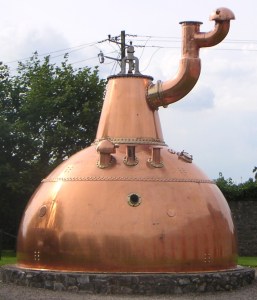
Jameson still, Cork (Photo: Stephan Schulz)

Some of those malts, Bunnahabhain* and Glenfarclas, for example, are notable for the taste of what the French would call terroir. Peat bogs, soil and rocks through which their water sources run flavor that water. In addition to the water, the spirit’s flavor is heavily influenced by the ingredients (mostly barley malt) and how they are treated at each step. In the preparation of what will become new make spirit, there is much attention to manipulating temperatures at each stage. The temperature of the wort is chosen to enhance the activities of enzymes converting sugars and later, to encourage fermentation. Variation in stages and their temperatures can affect flavor. One also reads of claims that the shape and composition of tuns, stills and washbacks will influence the flavor of the new-make spirit. Once distilled, the spirit meets the cask, where interaction with the oak (and its preparation, be it lightly toasted or charred) will have the second largest effect on flavor.

Continue reading “Whisky and Words: Island Malts”

Whisky and Words Number 16: The Balvenie Doublewood 12

A tale of two Grants
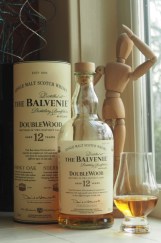
Balvenie's DoubleWood 12-year-old is tastefully presented.
Balvenie’s DoubleWood 12-year-old is tastefully presented.

The distance from J&G Grant’s Glenfarclas distillery to William Grant & Sons’ Balvenie location is but 13 miles by road; it’s a much shorter distance by helicopter. Both are Speyside distillers, and both offer whiskies finished in sherry casks. Like J&G Grant, William Grant & Sons is an independent company. Both started in the 19th century: William laid down his distillery in 1889 (finished in 1892); John Grant of J&G Grant bought Glenfarclas distillery (built in 1836) in 1865.

However, the William Grant company has since grown into the largest independent distiller in Scotland. In fact, with over 10% market share, William Grant and Sons represents the third largest producer of Scotch, behind Diageo and Pernod Ricard. Not bad for a family company.

Continue reading “Whisky and Words Number 16: The Balvenie Doublewood 12”