Whisky and Words Number 91: Blanton’s Single Barrel Bourbon

Blanton’s – a single cask expression from Buffalo Trace.

This was a gift. I’m not a big bourbon drinker but I appreciate thoughtful gifts: I was told Blanton’s is hard to get a hold of. The product certainly looks impressive in its uniquely shaped bottle and hand lettered label (for when it was ‘dumped’ and from which rick, warehouse and cask). Also, the cork has a pewter horse and rider on it – as cool as the Dead Guy bottle! But none of that affects how a whisky tastes, and if you have been to this blog before you know I look askance at heavy blandishments, both verbal and graphical. After 30 years in the tech industry I know that marketing is a fact of life. But one has to look through the smoke and mirrors and see where the rubber hits the road.

Continue reading “Whisky and Words Number 91: Blanton’s Single Barrel Bourbon”
Whisky and Words Number 90: McCarthy’s Oregon Single Malt

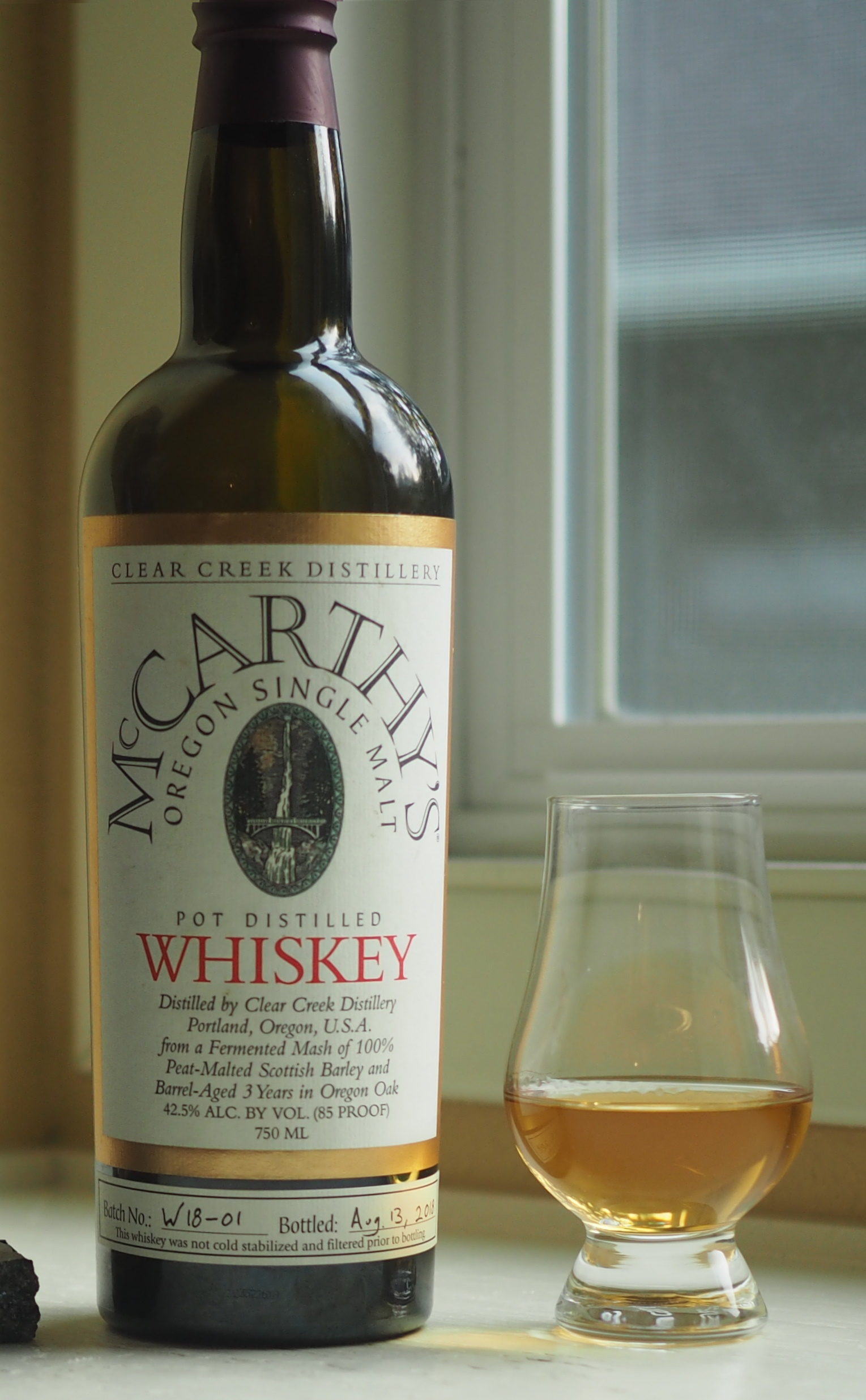
McCarthy’s – an Oregon Single Malt.

McCarthy’s is a product of Hood River Distilleries. The spirit itself is distilled by Clear Creek Distillery which has provided since 1985 a source for Oregon-made fruit-based liquors and purchased in 2014 by Hood River Distillers. By any measure, Clear Creek is a ‘craft’ scale operation, and in fact the bottle is hand-lettered for the batch and bottling date, as you can see in the photo (click for a high-res image).

According to the Hood river website, the spirit is “distilled in a Holstein pot still using one pass distillation from a fermented mash of 100% peat malted barley from Scotland.” The Holstein still is made from copper, like a pot still, but is an odd combination of pot still and columnar stills, so that in a single run you can produce a very pure spirit such as vodka and get in essence a dozen or more distillations (hence the reference to ‘one pass’ in the note above). This is is a different approach than in Scotland where a pot still is used for the first distillation (the wash still) and a second pot still (the spirit still) is used for the final distillation. Clearly, Clear Creek is taking the final cut from their Holstein long before they’ve distilled the flavor out (as you would with vodka.) Considering the different distillation approach as well as an aging of only 3 years (the legal minimum for Scotch), and different climate, you would not expect this to taste like a single malt Scotch.

Continue reading “Whisky and Words Number 90: McCarthy’s Oregon Single Malt”

Whisky and Words Number 51: Bushmills White vs. Jameson Irish

Today we battle it out with two titans of Irish whisky: Bushmills white label and Jameson Irish. Both being blends they are made from grain whisky (made from any cereal grain, often maize, in a column still) and pot still whisky. To be called ‘pot still’ whisky, the formal rule states (quoted from an excellent article here from Pernod Ricard):

Two heavyweights duke it out.

The Irish Whiskey Technical File lists that Irish Pot Still Whiskey must be made from a mash which contains a minimum of 30% malted barley and a minimum of 30% unmalted barley, with up to 5% of other cereals such as oats and rye added if required.

Note the use of unmalted barley, which differentiates Irish from Scotch whisky. Other rules state that the aging must be at least 3 years in oak. Like most Irish whiskies, the pot still component of both are triple distilled. The law states for a blend it must be “a mixture of any two or more of the styles of malt, pot still, and grain whiskey” (source whiskyadvocate).

Continue reading “Whisky and Words Number 51: Bushmills White vs. Jameson Irish”

Whisky and Words Number 50: Bunnahabhain 12 re-review!

It’s been a long time since I reviewed my old fave Bunna 12, and since then they have revamped the packaging, making it a good choice for the 50th review. The new packaging introduces a new style, new palette and a new Bunna captain as well.

The new 12. We expect great things.

Of the whisky inside, the features remain the same: 46.3% ABV, natural color, non-chill-filtered, “Double Matured in Ex Bourbon and Ex Sherry Casks.” What does that mean? The folks at Distell tell me Bunnahabhain “is made using 70% sherry casks with 30% bourbon casks, these casks are married (mixed) together in a vatting.” In this case, both sherry and bourbon casks will have been aged for at least 12 years. This is contrast to other part-bourbon, part-sherry offerings, like Glenmorangie’s Lasanta, where they start in bourbon casks and move to sherry for a final (shorter) maturation. So, Bunna is not actually ‘double matured,’ but the Bunnahabhain approach should result in a richer, more sherry-influenced profile.

Continue reading “Whisky and Words Number 50: Bunnahabhain 12 re-review!”