
Sure NAS whiskies get flack from whisky lovers. We consider the age statement a definitive mark of quality, care, and investment by the distiller. The distillers will come back at us with arguments that ‘no age statement’ expressions give them the freedom to pick the best casks, etc. But I have to think, if we as consumers roll over and accept this, we’ll be on the road to what wine has become. Manufactured. And there will be apologists for manufactured whisky as there are apologists for manufactured wine. Take the article in the New York Times by Bianca Bosker just last March. When I read it I was certain, until it concluded, that the piece was a tongue in cheek sendup. I mean, oak dust? Liquid oak tannin ‘(pick between “mocha” and “vanilla”)’ — really? Ms. Bosker promoted the idea that we should accept products designed by committee for easy drinking palates, further straining credulity. I do not exaggerate:
Tag: Whisky
Whisky and Words Number 20: Bowmore 12

Up next in our Island series is Bowmore 12. Bowmore certainly talks up its heritage on its packaging — founded in 1779, almost a century before the majority of distilleries on the island. Located on Loch Indaal (in the bight that nearly bisects Islay), the distillery is unique in that it has been in near-constant production since inception.
The Bowmore folks are proud of several key points: the balance of their whisky, the peatiness and smoke, and the use of their own malting floor. Note, however, like other distilleries (the Balvenie for example), modern production volumes outstrip the capacity of the island to produce barley or the old malting floors malt. At 2M liters produced yearly, Bowmore imports some of its malt. Still, the retention of their own floor malting shows a commitment to maintaining the old traditions and skills.
Whisky and Words Number 17: Lagavulin 16

The first expression in our peaty Island series is an old gentleman, Lagavulin. I’m starting here because I think ‘Laga’ is a damned fine whisky and, though a bit pricey, represents a benchmark for quality and complexity. It’s well-finished and very smooth despite the smokiness of the peat. They achieve smoothness and a full flavor without using sherry casks, and here is where the extra years in the barrel make a difference: most of its competitors (Islay whiskies) use a 10-year-old as their main expression. The extra six years Lagavulin spends in cask mellows the smokiness and allows lovely aromas to work in from the wood. You pay for that aging of course, this is about $90 a bottle in my area.
Whisky and Words: Island Malts
The blog has covered a number of blends, and also eleven unpeated, mostly sherry-finished single-malts (see sidebar for the list and links). They all share similar influences in their flavoring.
It’s the water, and a lot more
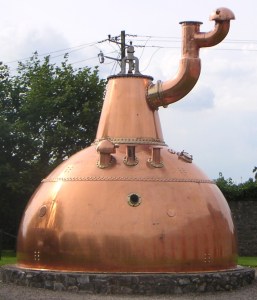
Some of those malts, Bunnahabhain* and Glenfarclas, for example, are notable for the taste of what the French would call terroir. Peat bogs, soil and rocks through which their water sources run flavor that water. In addition to the water, the spirit’s flavor is heavily influenced by the ingredients (mostly barley malt) and how they are treated at each step. In the preparation of what will become new make spirit, there is much attention to manipulating temperatures at each stage. The temperature of the wort is chosen to enhance the activities of enzymes converting sugars and later, to encourage fermentation. Variation in stages and their temperatures can affect flavor. One also reads of claims that the shape and composition of tuns, stills and washbacks will influence the flavor of the new-make spirit. Once distilled, the spirit meets the cask, where interaction with the oak (and its preparation, be it lightly toasted or charred) will have the second largest effect on flavor.
Whisky and Words Number 16: The Balvenie Doublewood 12
A tale of two Grants
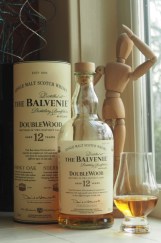
The distance from J&G Grant’s Glenfarclas distillery to William Grant & Sons’ Balvenie location is but 13 miles by road; it’s a much shorter distance by helicopter. Both are Speyside distillers, and both offer whiskies finished in sherry casks. Like J&G Grant, William Grant & Sons is an independent company. Both started in the 19th century: William laid down his distillery in 1889 (finished in 1892); John Grant of J&G Grant bought Glenfarclas distillery (built in 1836) in 1865.
However, the William Grant company has since grown into the largest independent distiller in Scotland. In fact, with over 10% market share, William Grant and Sons represents the third largest producer of Scotch, behind Diageo and Pernod Ricard. Not bad for a family company.
Continue reading “Whisky and Words Number 16: The Balvenie Doublewood 12”
 AlbinoTree.Net: Whisky (and book) reviews