Whisky and Words Number 70: Battle of the Speyside Giants: Glenfiddich 12 vs. The Glenlivet 12

Glenfiddich is the world’s best-selling single-malt whisky” according to Wikipedia. Though not quite as ubiquitous as Jameson’s (a blended), you can find Glenfiddich in about any bar. More remarkable is that Glenfiddich is a marque of William Grant & Sons, a family business, not a multinational, and yet they are number 3 in Scotch whisky production behind Diageo and Pernod Ricard. I have an unscientific survey (visiting bars for 30-odd years) and in my estimation, their closest competitor is The Glenlivet, another Speyside distillery (owned by Pernod Ricard) with a near-equal global reach. I’ve reviewed a number of their whiskies recently but the comparison for this head-to-head will be the Glenlivet 12-year.

To produce their worldwide reach, Glenfiddich employs an astonishing 31 stills to produce 13 M liters of spirit per annum. Their spirit stills are rather small (4550 l.). Compare to Glenmorangie’s 12 stills (6M liters per annum) or the Glenlivet’s 14 stills (10.5 M liters per annum). Even the mighty Macallan, which also uses small stills, has only 24, but produces 16M liters a year (per whisky.com). Continue reading “Whisky and Words Number 70: Battle of the Speyside Giants: Glenfiddich 12 vs. The Glenlivet 12”
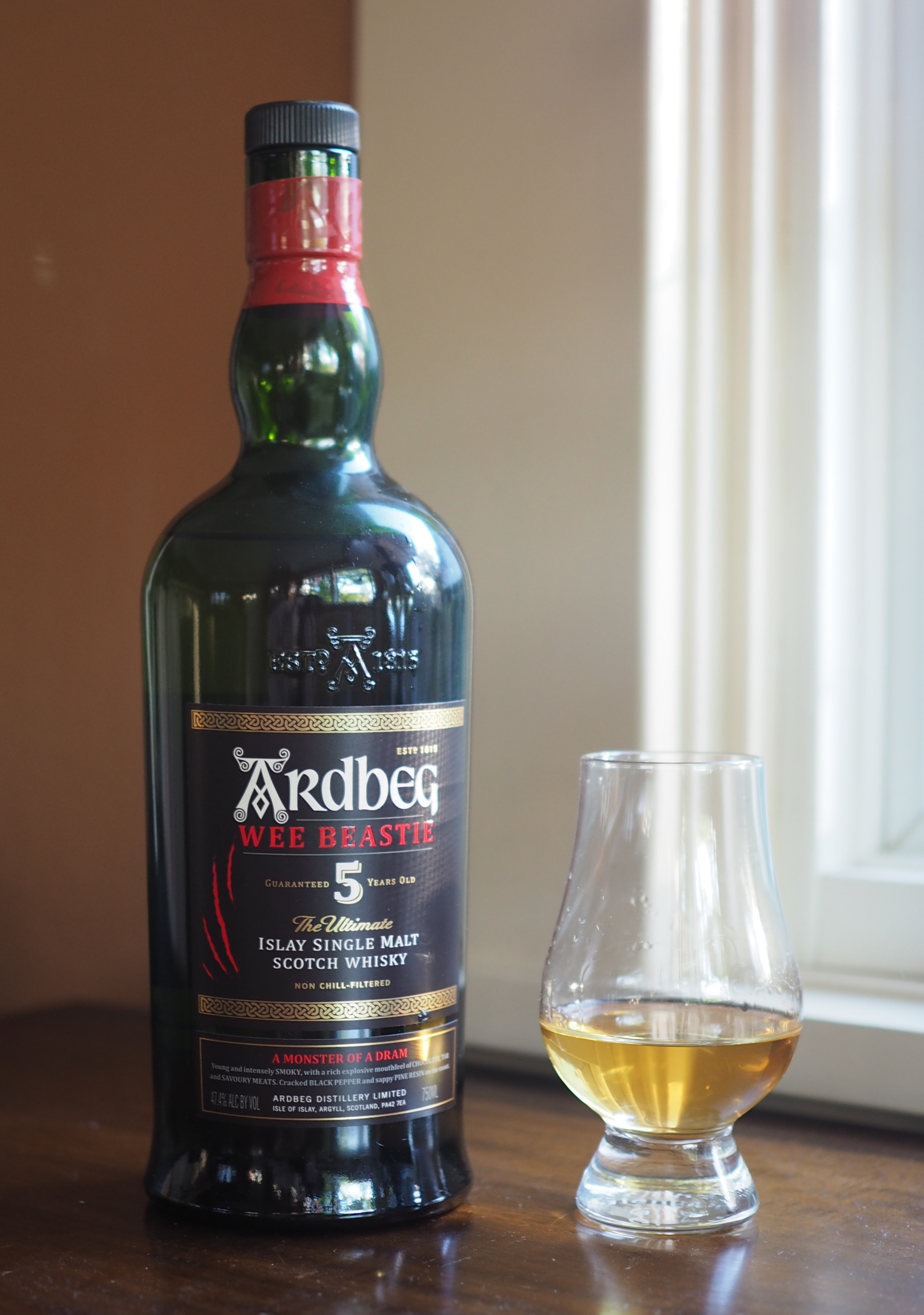
Whisky and Words Number 69: Ardbeg Wee Beastie

The Wee Beastie promises monstrous flavor.

Five years is sufficient to age a good bourbon in the American South’s hot, humid summers and mild winters. While Scottish law requires no less than three years maturation, the colder weather of Scotland means that most single malts are aged 10 years before release. There are a few 8-year single malts out there but that is not common.

One wonders why Ardbeg, known for a superb 10-year and a collection of standout NAS whiskies, would release a young whisky like the Beastie, and as a permanent selection at that. Other whiskies are made with spirit as little as 5 years old, but more typically, distillers hide the spirit’s youth behind an NAS label. The Wee Beastie label proudly proclaims 5 years of maturation. I expect economics plays a part. If Ardbeg can figure a way to market their younger spirit in a way that does not sully their reputation, they can increase output and thus market share.

Continue reading “Whisky and Words Number 69: Ardbeg Wee Beastie”

Book review: Blinded by the Right

While intensely informative and alarmingly eye-opening in its expose of intrigue, deceit and thuggery by the political right, this is not an easy read. Brock is brilliant but he wields his mastery of detail as a blunt instrument. He needed a stronger editor. If the book was to be an expose of the Republican smear campaign against the Clintons, the web of cronies, deceit and hijinks he illustrates is compelling. If the book is a dish on his enemies, the details of their hypocrisy are dishy. If it is a tale of a gay man’s collaboration and later fallout with the political establishment most at war with the LGBTQ population, he has that covered. If it is to be an act of repentance for his own (very effective) acts to smear both Anita Hill and the Clintons, he does recount in excruciating detail how he wandered into that thicket and slowly, excruciatingly found his way out. Along the way there is much grief, recrimination and a few healthy dashes of self-pity.

Continue reading “Book review: Blinded by the Right”

Whisky and Words Number 68: Laphroaig Lore

They have swapped the usual Laphroaig label color profile for a darker look, to match the richly colored spirit.

I gave Laphroaig’s Triple Wood a positive review a couple weeks back. Essentially their Quarter Cask whisky using Oloroso butts for a third stage, the ‘3Wood’ brought a punchy midrange of fruit and spice notes to the classic Laphroaig style. According to the carton notes, the Lore reads like a super 3Wood, as the spirit is “drawn from a selection of aged casks including first-fill sherry casks, smaller quarter casks and our most precious stock,” presumably of ex-Bourbon casks. The carton notes tell us the intent was to crate the “richest ever Laphroaig.” Like the 3Wood, the Lore is not chill filtered and is also bottled at 48% ABV. Frankly, using the Triple Wood as a starting point sounds like a good strategy to me. I assume they are taking the same recipe, but being more selective with casks. So I’ll use the 3Wood as a comparison for this review.

On the UK website, they state they use five different casks, aged 7 to 21 years. They also state Jim Murray listed Lore as the best NAS whisky in his 2019 bible. Promising! We won’t get much more info from Laphroaig’s website as they have terrible coverage of their range, just a shopfront. And their ‘contacts us’ page will not load if you have even the minimum protections on with your browser. Sorry Laphroaig, I’m not pulling my knickers down for you. Get with modern security! Anyway, the five types would be first-and-second fill Bourbon, same for Sherry, plus the quarter casks, there’s your five.

Continue reading “Whisky and Words Number 68: Laphroaig Lore”

Whisky and Words Number 67: Bruichladdich Octomore 8.1

Tall, slim, sophisticated and smoky. It’s not a cigar, it’s Octomore.

Last week I covered Bruichladdich’s Port Charlotte 10-year and mused about the big talk and heady claims printed on the canister. In that post, I added tidbits about the distillery itself and their approach to spirits-making. This week it’s less talk on the background a bit more focus on the whisky itself.

In contrast to the Port Charlotte’s wordy canister, Octom0re’s metal canister is in contrast quite restrained. The unsaid message here is that they don’t have to say anything about the Octomore besides it being “Super Heavily Peated” Islay single malt, and stating that it was conceived, created, distilled, aged etc. on the island. Like the PC10, it is un-chillfiltered and free of coloring.

If Port Charlotte is their heavily peated branding, you might wonder, what does ‘super heavily peated’ mean? One hint can be found on the canister: “PPM: 167.” That’s parts per million of phenols on the peated malt. What ends up in the bottle depends on the distilling process and maturation, even the type of oak, but PPM is a good benchmark to start with. See this post from scotchwhisky.com for more info. Our nose has to tell us how much of that phenolic potential made it into the bottle.

Continue reading “Whisky and Words Number 67: Bruichladdich Octomore 8.1”