For this post, a departure: not a whisky review, but a distillery tour review, of Glenfarclas. This was my first tour of a distillery, so the whole thing was new and fascinating. That’s fortunate, as I had planned no less than nine tours for our two-week vacation in Scotland. Frankly, my wife was dubious, but she came to really enjoy them. As we progressed across the whisky-making regions of Scotland, we did six other tours and learned that no two tours are the same. We also discovered aspects of the distillery experience we did not expect, and fortunately, we both found compelling. Onward! (Note, most photos can be clicked for higher res images.)
Glenfarclas Lobby Shop. You can see the entrance to the tasting room at the far end.Glenfarclas rare bottles. Can’t buy these, but…
Glenfarclas is about 20 minutes south of Dufftown. It’s set in a broad valley, which you can see in a flyover view here, at their website. The entrance is easy to miss driving south, so if you find yourself up among the piney hills, you’ve gone too far.
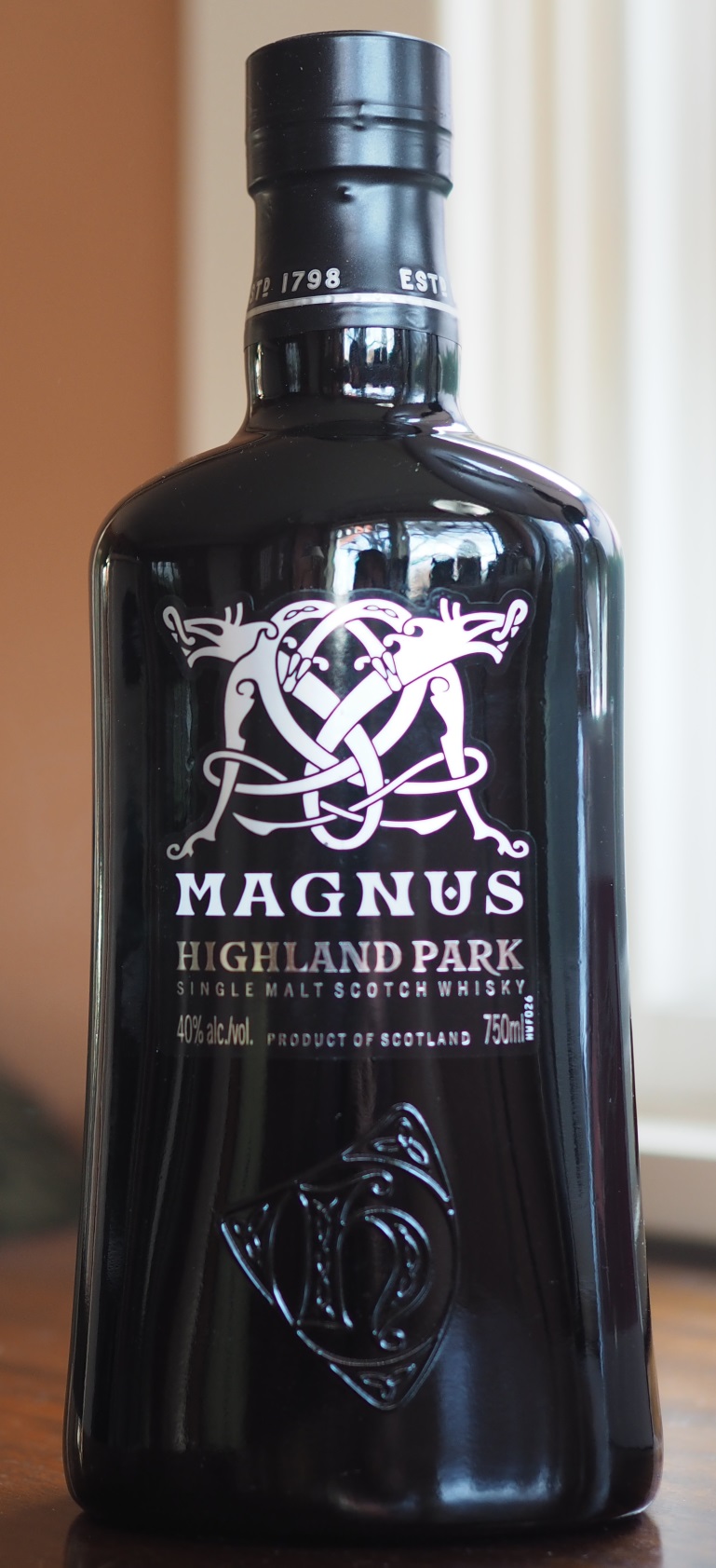
Another in the NAS series! Again I’ll weigh the stratagem of the distiller, and we’ll see if the malt master and his minions have created value for both distiller and imbiber. In this case, the Magnus is presented to us as a hearkening back to old ways:
A whisky crafted in the old way by a new generation of Vikings, MAGNUS bears the soul of our Viking ancestors and the name of just one – our founder, Magnus Eunson.
Magnus, a chap who set up a still on the Highland Park site in the 1700s, was a descendant of Vikings. I’m reading Churchill’s History of the English Speaking Peoples, and pretty much everyone in the UK and northern Europe in general is a descendant of Vikings. They got around, those Vikings. Anyway, that’s the theme set by the marketing wags. The presentation is heavy on atmosphere, with the opaque black bottle (right) and a distinctive new cap, which is a combo cork/screw-in with a lot of detail embossed (detail below). The screw-in feature is handy if you are too tipsy to push the cork in without letting slip the bottle. Drink responsibly.
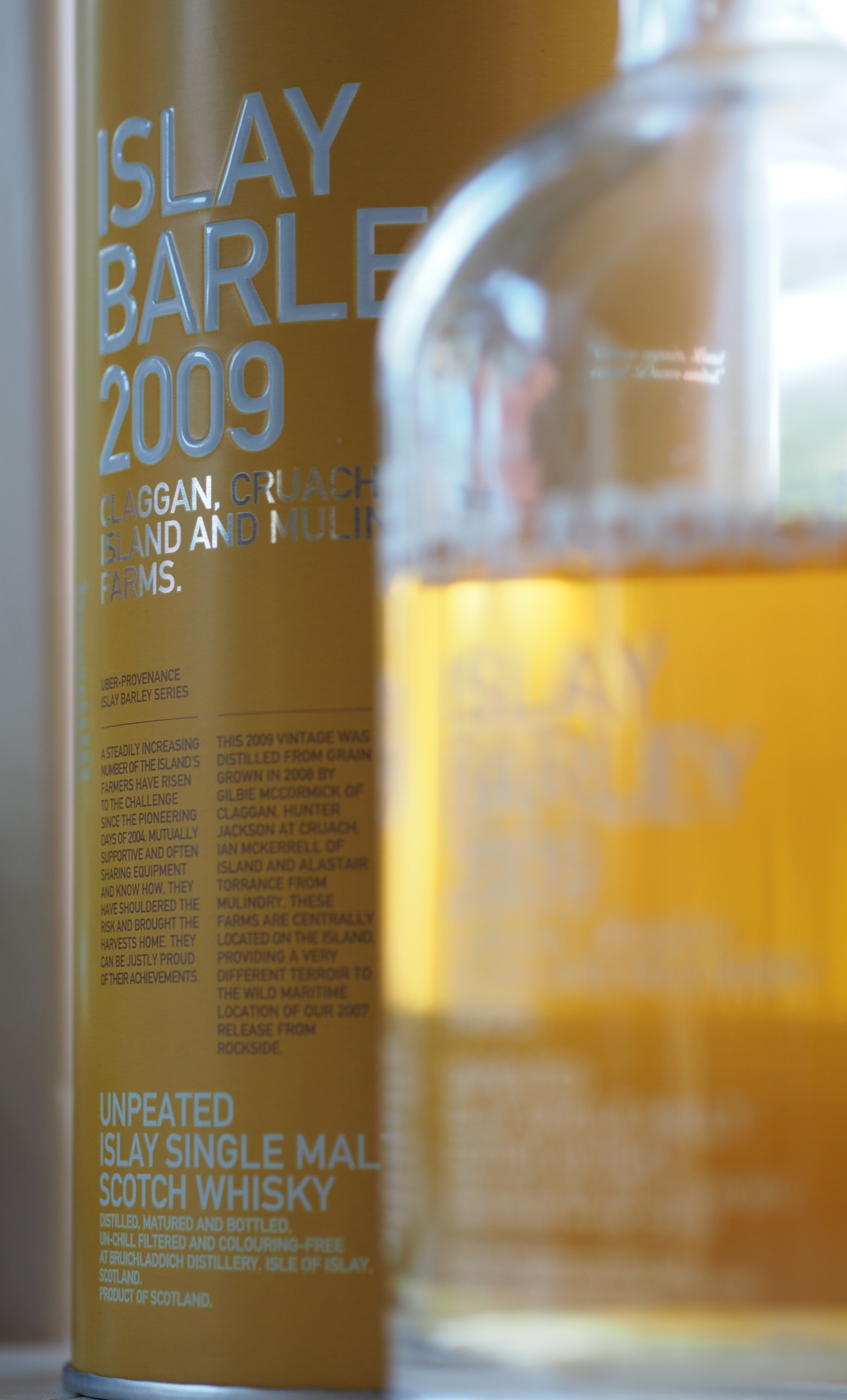
We’re off the NAS train for a bit, coming back from the underwhelming Dalmore KA III, back at you with another Bruichladdich. I’ll do a little compare and contrast with the Bruich’ Scottish Barley, AKA Classic Laddie. Note, the Islay malt does have an age statement. On the bottle it states “Distilled in 2009, bottled in 2015. Aged 6 years in oak casks.” So, this has been sitting around in bottles for two years. Similarly, the currently available Islay Barley shown on the Bruich website is from 2010. (Oddly, where the 2009 is redundant stating the time spent in cask, the 2010 bottle is silent on that subject.) So, you wonder, how does a 6-year old stack up to the standards from other distilleries aged 10-12 years? We’ll see below. Let’s see what goes into making this whisky.
Click to expand, you can read their record of provenance.
First of all we have to recognize Bruichladdich as a distiller with an intense focus on how the whisky is made and from what. Not that other distillers are unfocused–I did visit a number of them this year–but these folks really take terroir to a fanatical level. My Islay Barley’s canister (photo alongside) boasts ‘Uber-provenance’ and names the Islay farms from which they sourced their barley. There is a lot of text about what was happening on the farms the year the barley was grown. It’s worth a read. We also find their credo on the canister, they “believe in Islay…in people..in authenticity provenance and traceability. We believe in slow.”
This whisky, the Dalmore King Alexander III (KA III forthwith) was a gift, and I am grateful for it. Especially as this retailed for over $300 when our local stocked it (it’s a state-owned store and they rotate brands, it is gone now). That price is definitely out of my ‘I’ll try it on a whim’ range. One wonders at the price, especially for a NAS whisky. What are we buying? There is a fancy box, as you can see (bottom of post), and all those flaps provide lots of inspiring verbiage:
A note on the box art, The Death of the Stag, a fine painting at the Scottish National Galleries (I saw it, an impressive painting indeed) on the right inner flap.
A note about the Dalmore Custodians, their loyalty program on the left inner flap.
Dalmore history, Dalmore’s general approach to marrying spirit, and KA III tasting notes (box rear).
So what does Dalmore bring to the party? Does this hyped-up NAS hold up?
Known alternately as Scottish Barley and The Classic Laddie, this expression from craft-distiller Bruichladdich is a NAS whisky.
I have to admit a fondness for the place after having visited; I like their style. It was our last day on Islay, and after a busy morning walking from Port Ellen to Ardbeg (more on that later!) we decided to head out into the hinterlands for a drive. We took the road out to Port Charlotte, a tiny village at the end of which the A847 went from two lanes to one. That was all for me, I had had a bellyful of driving on tiny little roads and we headed back the way we came. Portnahaven would wait for next trip!
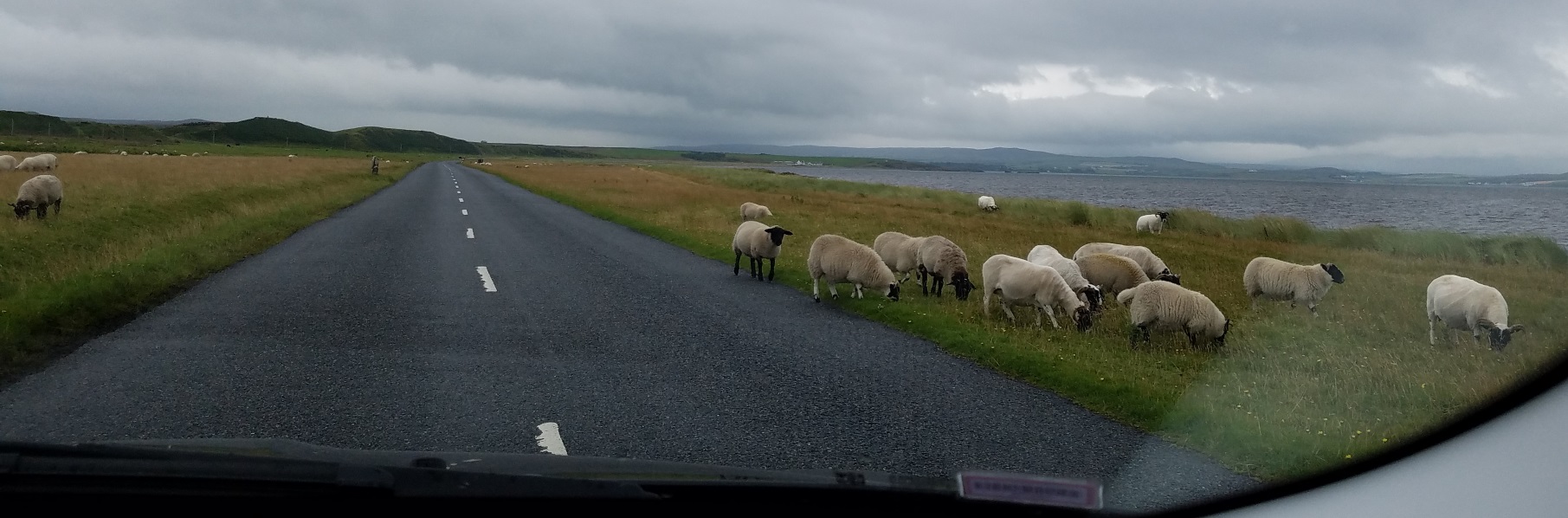
On the way back, we dropped by Bruichladdich. The distillery had been enthusiastically recommended to us by ‘Uncle Charlie,’ our taxi driver for the Bunnahabhain/Caol Isla visits (more on that later as well). I unfortunately was tired of photography so I have no photos, sad to say. Except this one, of some local creatures which had just scurried out of our way:
What, they think they own the road?Just a dram, please.
It’s an interesting little place, a whitewashed structure and wall, through which you pass into an intimate little courtyard to park. The tasting room is through a brightly painted (turquoise) door, low-ceilinged, liberally provided with couches on which whisky overs lounged in quiet repose. There was the usual display of t-shirts, jackets and the like, and a wide bar where a kindly woman of mature years welcomed us gaily and immediately offered us a taste. Why, of course, why not? I expected the usual: “Here’s our standard, if you want more sign up for a tour.” But she led us energetically through tastings of four expressions (of which I took the tiniest sips, as I was still driving, grr.) We had the Classic Laddie, the Islay Barley (both unpeated), the Port Charlotte and Octomore (latter two peated). Note: though I growl about NAS whiskies, these all lacked an age statement and yet I enjoyed them all.




 AlbinoTree.Net: Whisky (and book) reviews