Whisky and Words Number 35: Caol Ila 18

Caol Ila 18..what has it to do with an old stompbox? Just the colors…eerie!

My wife and I each have a favorite island whisky, a whisky that has a twist. In both cases, the twist is a medicinal quality brought forward by the phenols imparted by the peat smoke used to dry the malt. The expressions and their unique flavors vary between distillers. For me, the peaty, weird island favorite is Talisker. For my wife, it is Caol Ila.

We came upon Caol Ila off-handed: a neighbor brought a bottle of the 12 to a tasting at my house and said, “Someone gave me this, I don’t like it. You can have it.” I am not one to turn down a single malt. I thought the flavor a bit odd; it had a hint of nineteenth century mouthwash. But the wife lit right up. “I like this stuff,” she proclaimed, and grabbed the bottle. We’ve had it on hand since as a peaty alternative to the usual ‘nice’ drams like Glenmorangie, which she favors as a daily driver. I’ve even got used to it.

Continue reading “Whisky and Words Number 35: Caol Ila 18”

Reflections on Non-Age Statement Scotch Whiskies

This post will appeal best to those who read The Economist. If that’s not you, this entry will appear rather wonkish; you might want to skip to the bottom for the summary of tested expressions.

Why NAS?
NAS as a concept has taken the industry by storm in the last five years. This trend is driven by two factors: a restriction in supply of aged whisky used in traditional expressions and increased demand in the Far East (backstopped by continuing popularity in the West). And unlike other products, the supply of suitably aged whisky is restrained in an insurmountable way: there is no way to go back in time and put more whisky in barrels.

The supply and demand interaction has two facets: if the distillers don’t react to higher demand with higher volume, the inevitable result is higher prices for their product and customer discontent; secondly, if the distillers fail to capture their share of the growing market, they risk losing market share to rivals.

Continue reading “Reflections on Non-Age Statement Scotch Whiskies”

Whisky and Words Number 31: Ardbeg Corryvreckan

This is the final post in the NAS series for now. I’ll write up a wrap-up article in a week or two.

Ardbeg, pretty spiff place.

I read about Ardbeg long before I had a chance to taste it. A distillery raised from the dead, so to speak, it had been shuttered for eight years in the 1980s. Production resumed slowly under a caretaker administration by Hiram Walker in the early 1990s. Glenmorangie bought it in ’97 and resurrected Ardbeg to full production. Blessed with great stocks of old whisky aging in the warehouse, they released notoriously good (and peaty) whiskies throughout the early 2000s. They presented Ardbeg in a craft style – no coloring, non-chill-filtered, higher ABV. Their 10-year is released at 46%, and it is a damn good whisky, as I reviewed here. Despite relatively low production, about 1.25 million liters a year, they have a number of expressions.

Continue reading “Whisky and Words Number 31: Ardbeg Corryvreckan”

Whisky and Words Number 30: Highland Park Magnus

Reminds me of 2001, a Space Odyssey.

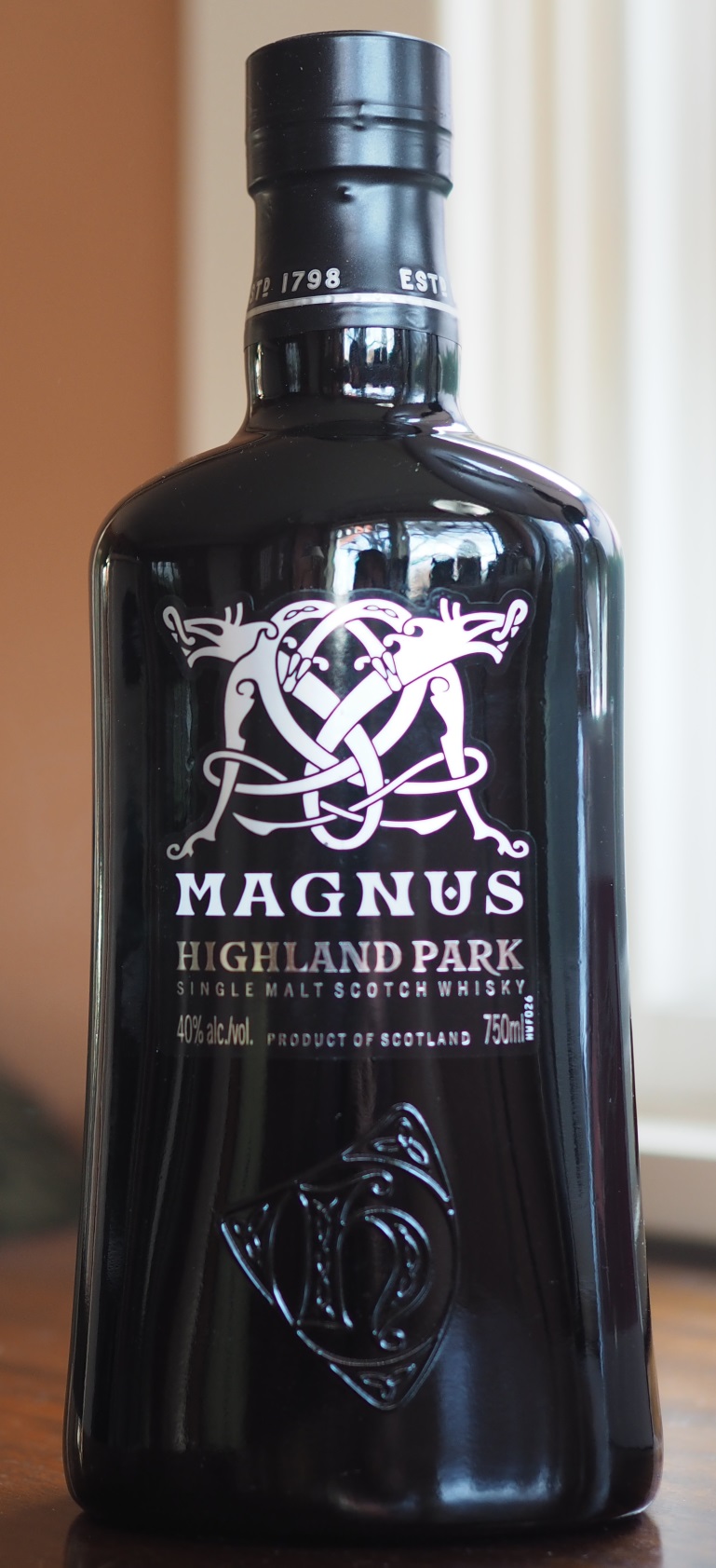
Another in the NAS series! Again I’ll weigh the stratagem of the distiller, and we’ll see if the malt master and his minions have created value for both distiller and imbiber. In this case, the Magnus is presented to us as a hearkening back to old ways:

A whisky crafted in the old way by a new generation of Vikings, MAGNUS bears the soul of our Viking ancestors and the name of just one – our founder, Magnus Eunson.

Magnus, a chap who set up a still on the Highland Park site in the 1700s, was a descendant of Vikings. I’m reading Churchill’s History of the English Speaking Peoples, and pretty much everyone in the UK and northern Europe in general is a descendant of Vikings. They got around, those Vikings. Anyway, that’s the theme set by the marketing wags. The presentation is heavy on atmosphere, with the opaque black bottle (right) and a distinctive new cap, which is a combo cork/screw-in with a lot of detail embossed (detail below). The screw-in feature is handy if you are too tipsy to push the cork in without letting slip the bottle. Drink responsibly.

Continue reading “Whisky and Words Number 30: Highland Park Magnus”

Whisky and Words Number 26: Talisker Storm


Talisker Storm

This is the first of three straight NAS whisky reviews. I relented on Talisker’s Storm when the price came down, from over $55 locally (Oregon) to just under $50. The original price was not so obnoxious as some NAS whiskies — I tried a Dalmore King Alexander III recently, for example, which runs $305, and Ardbeg’s Corryveckan is about $90. But still, $55 is the range where you can get a nice 12-year-old.

The standard Talisker 10, one of my favorites, isn’t cheap of course, at about $65 locally, so the opportunity to fill the Talisker-sized hole in my liquor cabinet for fifty bucks was too good to pass up. So, how does the Storm compare? After all, it is a Talisker, and we have expectations: of light peat smoke, a unique medicinal nose, shades of wrack and seaweed, citrus and fruit.

Continue reading “Whisky and Words Number 26: Talisker Storm”