Whisky and Words Number 90: McCarthy’s Oregon Single Malt

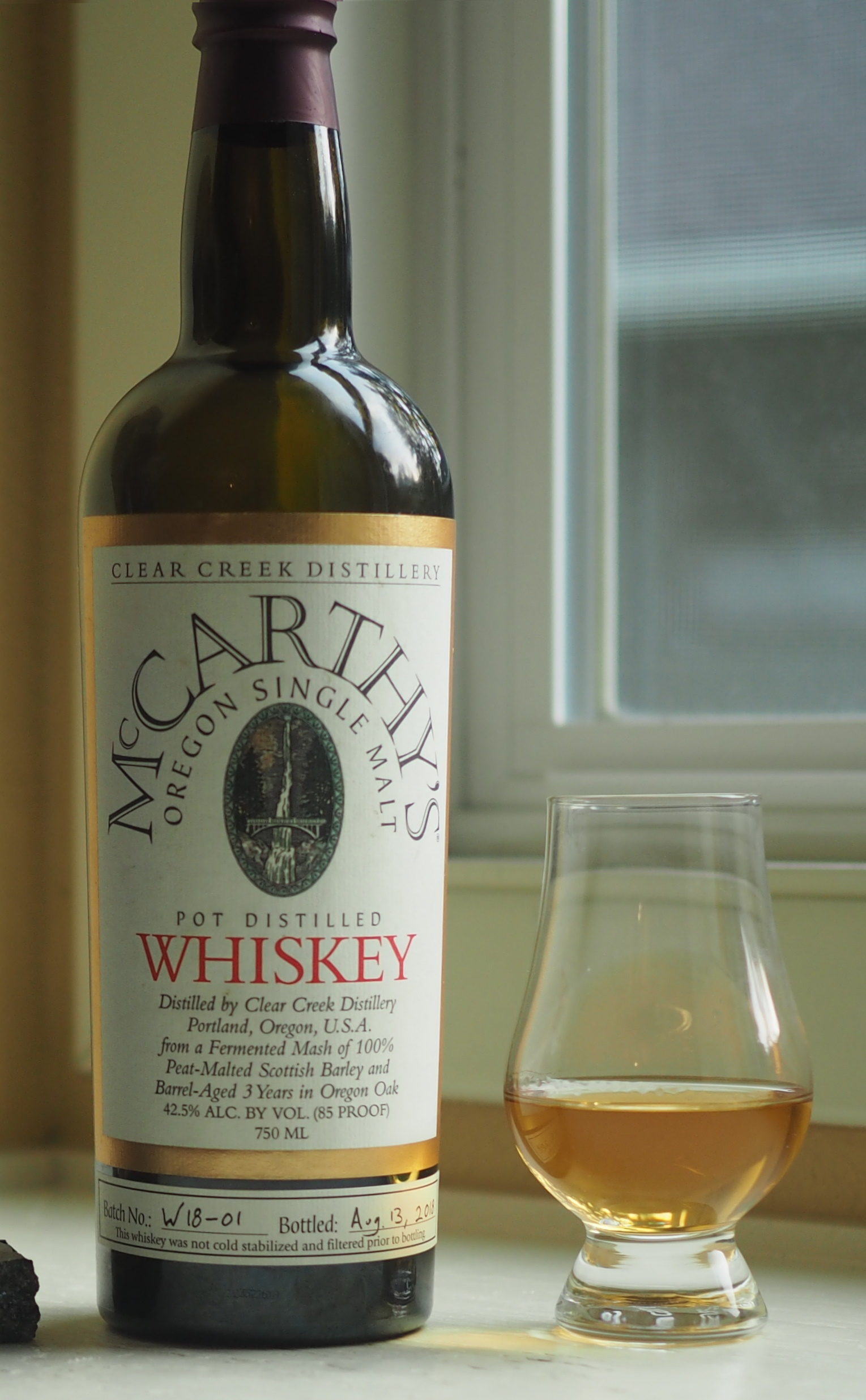
McCarthy’s – an Oregon Single Malt.

McCarthy’s is a product of Hood River Distilleries. The spirit itself is distilled by Clear Creek Distillery which has provided since 1985 a source for Oregon-made fruit-based liquors and purchased in 2014 by Hood River Distillers. By any measure, Clear Creek is a ‘craft’ scale operation, and in fact the bottle is hand-lettered for the batch and bottling date, as you can see in the photo (click for a high-res image).

According to the Hood river website, the spirit is “distilled in a Holstein pot still using one pass distillation from a fermented mash of 100% peat malted barley from Scotland.” The Holstein still is made from copper, like a pot still, but is an odd combination of pot still and columnar stills, so that in a single run you can produce a very pure spirit such as vodka and get in essence a dozen or more distillations (hence the reference to ‘one pass’ in the note above). This is is a different approach than in Scotland where a pot still is used for the first distillation (the wash still) and a second pot still (the spirit still) is used for the final distillation. Clearly, Clear Creek is taking the final cut from their Holstein long before they’ve distilled the flavor out (as you would with vodka.) Considering the different distillation approach as well as an aging of only 3 years (the legal minimum for Scotch), and different climate, you would not expect this to taste like a single malt Scotch.

Continue reading “Whisky and Words Number 90: McCarthy’s Oregon Single Malt”

Whisky and Words Number 89: The Arran Cask Finish – Sauternes

The Arran Cask Finish, Sauternes, liquid sunshine.

I originally brought in the Arran Cask Finish Sauternes for a comparison to the Glenmorangie Nectar D’or, in review 49. But this whisky deserves its own post. The Island of Arran has some history with illicit whisky-making, and one legal distillery ran in the 1800s. The Arran distillery was made new in 1994-1995, founded by a private company, Isle of Arran Distillers Ltd. As far as I can tell, Arran is still an independent distiller (with a new sister distillery also on the island, Lagg).

I paid $77, for this dram in 2019, though it’s up to $86 now with the tariffs. The Arran is  true craft offering, bottled at 50% ABV, non-chill filtered and uses no artificial colors. It is a really gorgeous dram as you can see from the photos (click for a hi-res view), a very clear medium amber. The front label declares ‘Each cask is specially selected by our master distiller’ and signed by James MacTaggart. You can see James here, in their brief profile. 45 years in the industry marks James as an old hand indeed.

Continue reading “Whisky and Words Number 89: The Arran Cask Finish – Sauternes”

Whisky and Words Number 88: Stein Distillery Rye Whiskey, 2 yrs

From the dry and windswept plains comes the Ram rye.

As I covered in the review of their bourbon, Stein distillery (website) is a small, craft distiller in Joseph, Oregon. This is not the damp and mossy Oregon where I live; Joseph is located in the high plains, with sunny, hot summers and cold winters. They’ve been around for 12 years now and I found the straight Bourbon quite good.

According to the hand-written notation on the label, my rye is bottle 8 from barrel 560—that’s a tell on the scale of the Stein operation. They are small. And they are local. You can read about how they source their grain from Eastern Oregon farmers in a profile about the family-built and family-run operation here. Their website is spare—you can see photos of their spirits and a short writeup on their whiskies here. But they provide no info on the mash bill or any other production details. Stein calls this spirit ‘straight rye,’ but that just means it is not blended with any other spirits and it is aged at least 2 years.

Continue reading “Whisky and Words Number 88: Stein Distillery Rye Whiskey, 2 yrs”

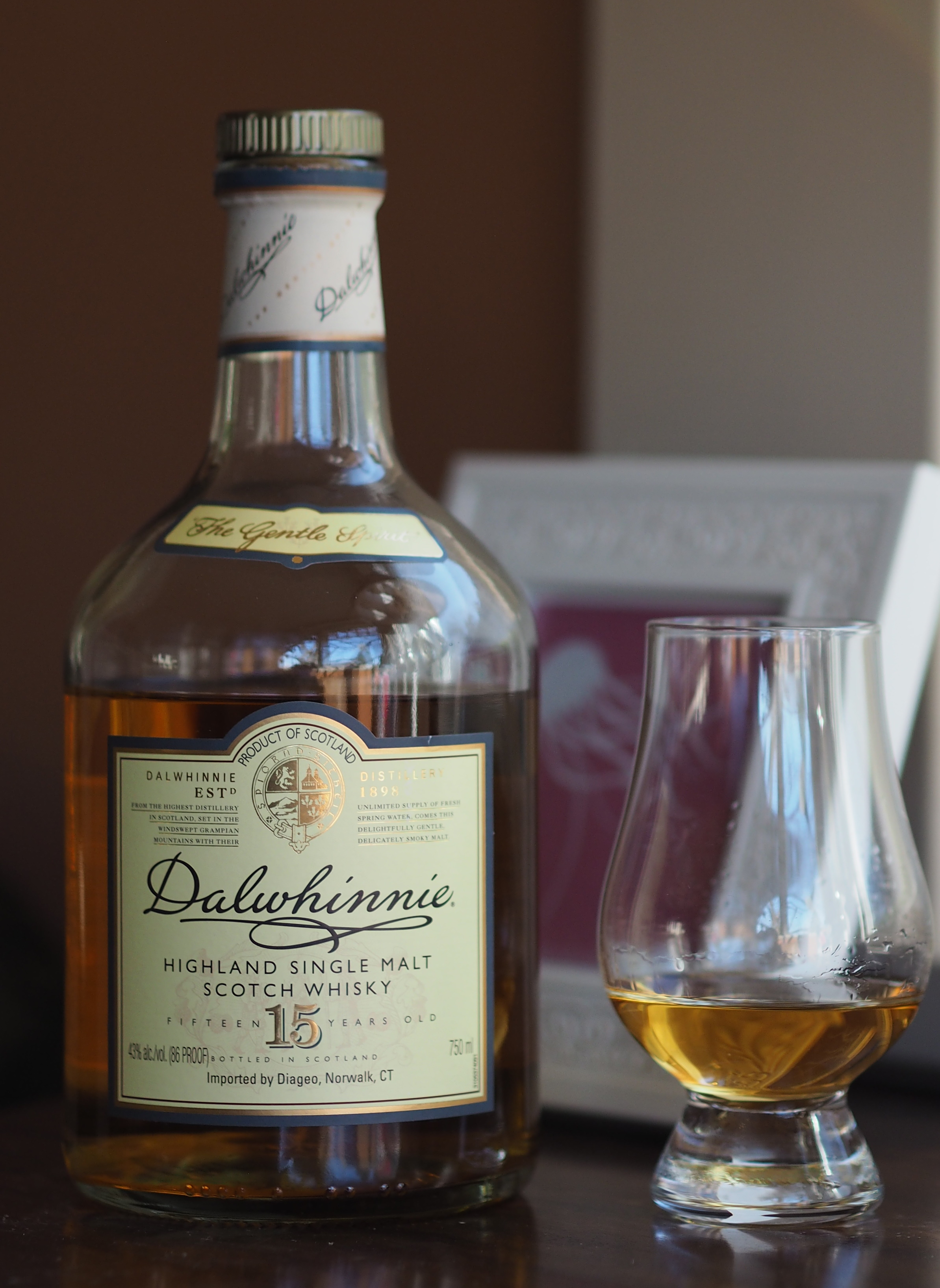
Whisky and Words Number 87: Dalwhinnie 15 (vs. Clynelish 14)

Deep color and a stout bottle with classic labeling.

Dalwhinnie 15 is a whisky that has flown under my radar for too long. Before the pandemic, the Dalwhinnie was mentioned by a whisky buddy as her favorite. I smacked myself in the forehead, of course! How had I missed it?

Located on the Trium, a tributary of the Spey, Dalwhinnie is considered both a Speysider but also a Highland distillery. The distillery is located on the far side of Cairngorms National Park from Dufftown (heart of the Speyside region) and they brag about it being the highest and coldest whisky distillery in Scotland, so I’m approaching it as a Highlander and will compare to the Clynelish 14, a lower-priced dram, but also a Highlander. Both are from Diageo and I’m interested to see how they are differentiated.

Continue reading “Whisky and Words Number 87: Dalwhinnie 15 (vs. Clynelish 14)”

Whisky and Words Number 86: Glenfiddich 15 Solera (vs. Glenlivet 15 French Oak)

Glenfiddich 15 Solera, deep color, rich aroma.

Glenfiddich is made by the same outfit that produce the Balvenie, and right next door at that, in the heart of Speyside. I find their 12-year okay, along the lines of the Glenlivet 12. In fact they duked it out in Glenfiddich’s 12-year review, the Battle of the Speyside Giants. The Glenfiddich 12 had a good nose, was not too sweet, sported some floral notes, was smooth, and not much of a finish. I covered the Glenlivet 12 here. Today however we’re stepping up a fair bit to the Solera Reserve 15-year. We’re a further $20 up the road from the 12, what’s the big deal?

Of course, this spirit has been 3 years in cask longer than the 12 but also developed from whiskies in a range of casks: the typical ex-bourbon, but also new oak and sherry casks. The new oak is a twist on the regular 12, but the big deal here is the vatting, where the selection of casks for the bottling are married. That’s where the Solera vat comes into play. As noted in the 12-year review, Glenfiddich uses oak tuns for the marry; furthermore, these Solera tuns are never emptied. As we read on the back of the carton, these tuns “host an infinity of malts.” William Grant also add a blurb about being family owned, which is quite remarkable for such a large producer.

Continue reading “Whisky and Words Number 86: Glenfiddich 15 Solera (vs. Glenlivet 15 French Oak)”