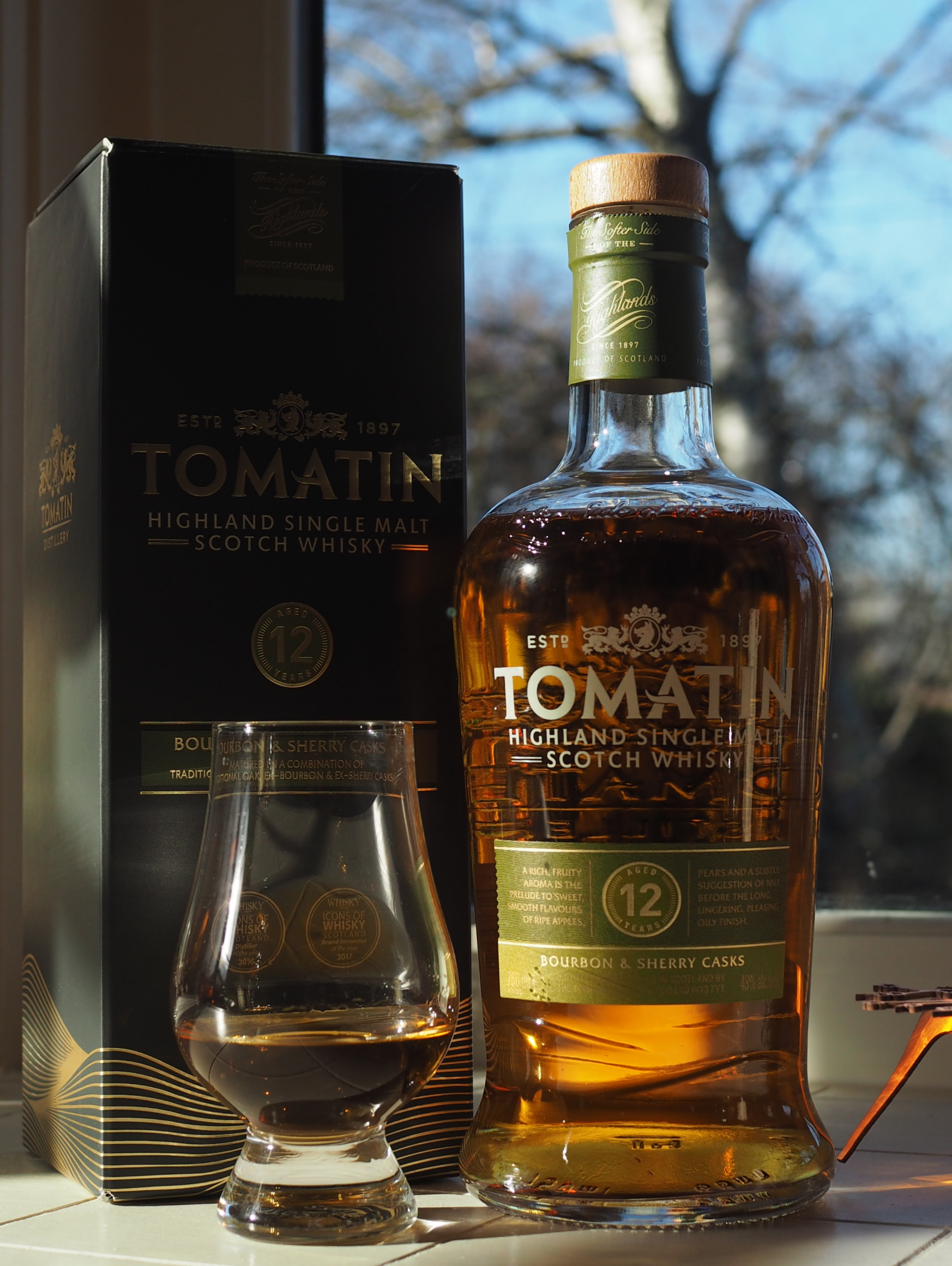
This is another review I have to credit to my local scotch-loving spirits retailer, Kelly. His recommendation for Oban was spot on, so I gave him heed when he told me the Tomatin 12 was akin to the Balvenie Doublewood (which I really like) and at a comfortable discount to the Balvenie. Tomatin sells for about $36 here in Oregon, whereas the Balvenie retails for $62. Frankly I think it’s a tall order for anyone to take on The Balvenie, but let’s give Tomatin a fair shake.
I’ll be the first to admit I’m not a frequent bourbon drinker, and I have to look up the code words that go along with bourbons—in this case, “straight.” According to Angel’s Envy, to be sold as “whiskey” in America, a spirit must adhere to the Pure Food and Drug Act (1906). To wit: the spirit has to be “straight,” that being defined by certain proofs at casking and bottling, being cut with only water and, most importantly, aged for 2 years. In this review, we’re looking at a 5-year-old bourbon. That doesn’t sound like much aging to a Scotch drinker (minimum 3 years in Scotland but 10-to-12 is more common) but there is the climate to consider.
In the previous post, I mentioned Dewar’s old full-page magazine ads, with the Scots Guard soldier or some other Scottish kitsch. I also mentioned the ubiquity of White Label, the fifth largest selling blended Scotch in the world and top selling Scotch in the U.S.
Dewars TRUE SCOTCH!
Dewar’s web site claims the White label is “The World’s Most Awarded Blended Scotch Whisky.” This post is going to answer the question, is it any good for sipping? And to give it some spice, we’re setting the White up against a competitor, the Red, from Johnnie Walker.
The Dewar’s packaging, like the ’12’, is in a classic style, again heavy on the heritage with “True Scotch” announced just below the “White Label”, rendered in some old-timey font. Boy howdy, glad to see we don’t have a fake scotch on our hands. I have a warm feeling inside (and I haven’t even tried any), like when I get the Domino’s box with ‘Real cheese’ emblazoned on the side. Lower down we see the ‘Gold and Prize 500 medals’ claimed. I guess they are including silver, bronze, even iron medals? Who knows.
If you were of my generation, you’ll remember Dewar’s ads from magazines–often full-page ads, typically with a Scots Guard soldier in full regalia and some marketing flack typical for its day. These days I don’t notice many advertisements for Dewar’s. When I encounter the brand I’m on a commercial flight and I’ve asked what they have for scotch; it’ll be their White Label. In the marketing wars the brand appears to be outshone by the massive Johnnie Walker complex, but they still have a strong presence in bars in the U.S. They claim to be the fifth largest selling blended Scotch in the world and top selling Scotch in the U.S. Maybe Johnnie just advertises more?
Notably, Dewar’s web site claims the White label is “The World’s Most Awarded Blended Scotch Whisky.” Maybe they just entered more competitions, I don’t know. I tried finding a list of their awards. Still looking.
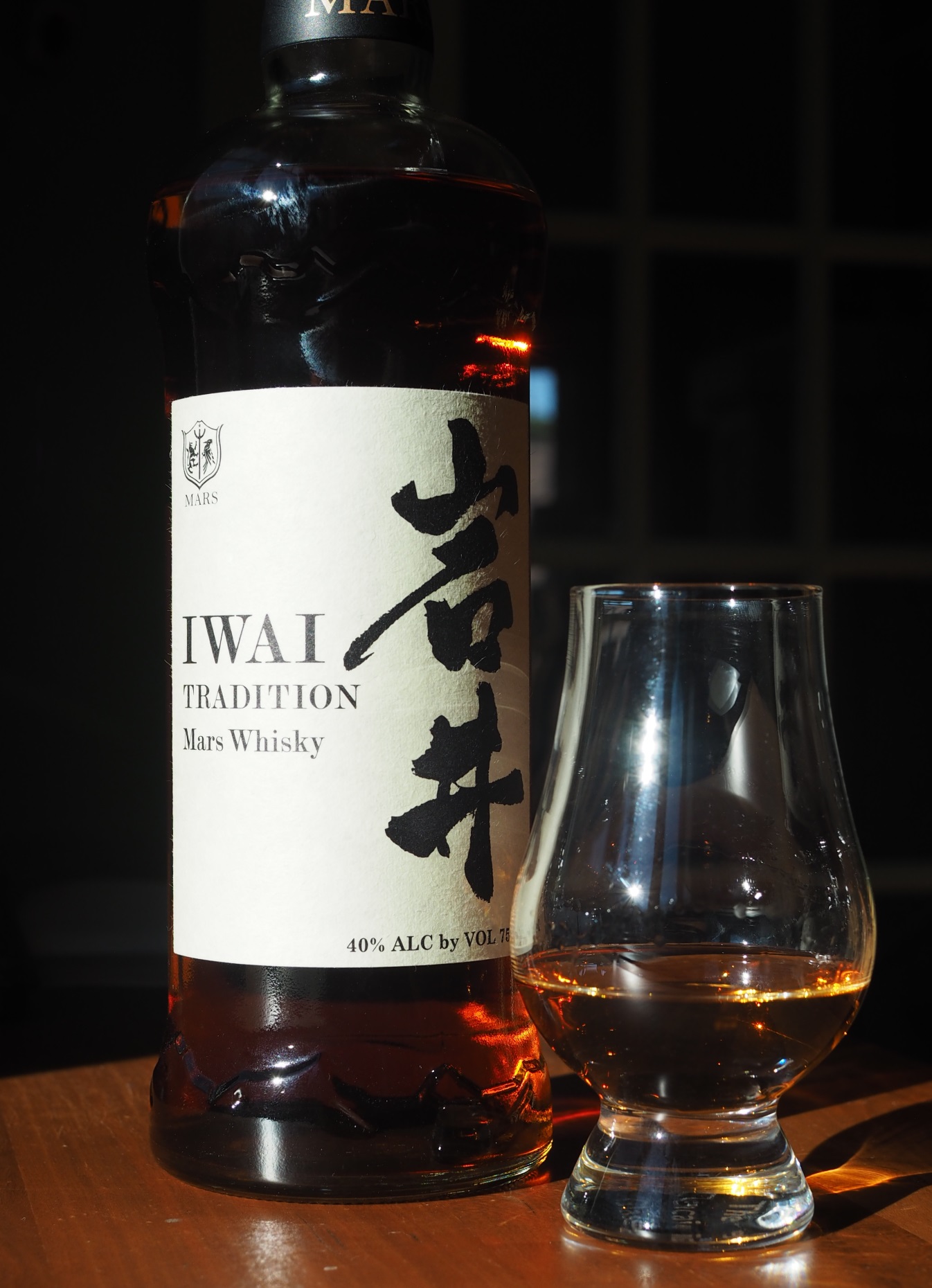
I’m finally getting my holiday post up, a bit tardy I must say. This one is a real departure for this blog, which thus far has all been Scotch whiskies. The Mars Shinshu Iwai is, as you would guess, from Japan. The style is different from what I’ve been reviewing here, as it is an American ‘whiskey’ style — corn mash, shorter maturation (but one would assume at higher temperatures than Scotch, as typical for American whiskies). Oddly the Iwai folks spell it ‘whisky’ on the bottle like the Scotch.
The importer’s website tells us that the moniker Iwai comes from Kiichiro Iwai, a ‘silent pioneer’ of Japanese whisky-making. With a little digging (thanks to gourmantic.com) we find that Iwai-san ran the Mars distillery years ago. The timeline they give is confusing, as the Mars distiller was licensed in 1949, commenced producing in 1960, but according to Gourmantic, Iwai-san had sent a junior member to Scotland to investigate their whiskies in 1919. At any rate, the distillery is in the Japanese highlands — 800m above sea level, a decent highland for sure.



 AlbinoTree.Net: Whisky (and book) reviews