Whisky and Words Number 13: Glenfarclas 12

Glenfarclas 12. Unassuming packaging, excellent whisky.

I’m an engineer of sorts…I don’t hold an engineering degree but my entire post-military working life has been designing, writing, testing and explaining software and computer systems. There is a natural dynamic between the messaging folks (marketing) and the engineers. We techies like to know what’s what and make our own decisions. Marketing’s job is, as we see it, to spiff up, deflect, and entice. That might be fine for the hoi polloi, but we engineers like to think we’re immune to such blandishments.

Well, of course we aren’t, marketing is a powerful force and here to stay, but it sets my heart all aflutter to encounter a company like Glenfarclas. To say they are transparent about how they create their product would be an understatement. This starts at their website, which is professional but not the most visually stunning. It’s probably considered a couple years behind the times as far as design, yet I appreciate it for the amount of information they place at your fingertips. It is amazing. Furthermore, their brand ambassador manning the email trenches is similarly forthcoming (thank you, Myriam). This is a huge benefit to those of us who want to know just what it is we are drinking, how it is made, why it tastes as it does.

Continue reading “Whisky and Words Number 13: Glenfarclas 12”

Holiday buying guide for those with a Scotch lover on the list

So, you have someone you know is ‘into’ Scotch and you want to buy a nice present. You don’t want to set a foot wrong, and certainly don’t want to see her writing about your present as “the Scotch I save for folks who don’t know Scotch, or drown it in Coke.” Yes, I’ve read that on many a Scotch blog. Rude, I think…but it happens — because A) The styles of Scotch vary wildly in their aroma and taste (why it’s a fascinating obsession, yo!) and B) Scotch drinkers are often quite partisan about their preferred style.

Prep: Single malt vs. blend, and U.S. availability

We’re going to focus mostly on single malt scotches — this refers to a whisky that is made totally from one distillery’s production. They can (and do) mix casks and even years of production for a single malt. But as soon as they mix casks from another distillery and add grain alcohol (mass-produced, typically), then it is a blend. Common blends are well-known, like Johnnie Walker, Chivas, Dewars, Whyte and MacKay. These are the province of the casual drinker, not the Scotch enthusiast. Single malts will have more character, as the peculiarities of water and still are not blended out — hence they appeal to folks looking for adventure. Note: my focus is on brands available in the U.S., as that’s where I live.

There is a bit more to learn, so let’s do this in steps. We’ll gather some intelligence, align that to some facts, and send you shopping with a budget and some suggestions.

Continue reading “Holiday buying guide for those with a Scotch lover on the list”

Whisky and Words Number 12: Glenmorangie 18

Glenmorangie 18 and glass

Many times, distillers will change up the finish on older releases. They’ll go with a peated version rather than the unpeated 10 or 12, or they’ll finish in sherry barrels, where the younger releases are not. The whisky under review today, the “Extremely Rare” 18-year-old Glenmorangie, is fairly true to its 10-year-old sibling. But they do decant a chunk of it (about 30%) and age it for the last three years in Oloroso sherry casks before the final blend.

The other changes are superficial. The bottles are similar, although not exact; the 18’s bottle is a bit stouter, more curvaceous, and a bit shorter as a result. The whisky is a bit darker than the 10, which could be the small amount of sherry finish or a bit of E-150; they don’t claim not to use it.

Continue reading “Whisky and Words Number 12: Glenmorangie 18”

Whisky and Words Number 11: Glenmorangie 10

Glenmorangie 10
Glenmorangie 10

While Glenmorangie (rhymes with ‘orange-y’) has a solid pedigree (see below) and great affirmation as “the most popular malt in Scotland” (according to DrinkBritain and others), they aren’t above a bit of marketing puffery. They boast “air-dried” bourbon casks. That’s good, as it’s difficult to dry casks underwater, for example. Though I suppose some new-age Gen-Z whisky maker will come out with vacuum-dried casks, just because they can. But no matter, what concerns this writer is the taste, and Glenmorangie is OK there.

Continue reading “Whisky and Words Number 11: Glenmorangie 10”

Whisky and Words Number 10: Cardhu 12

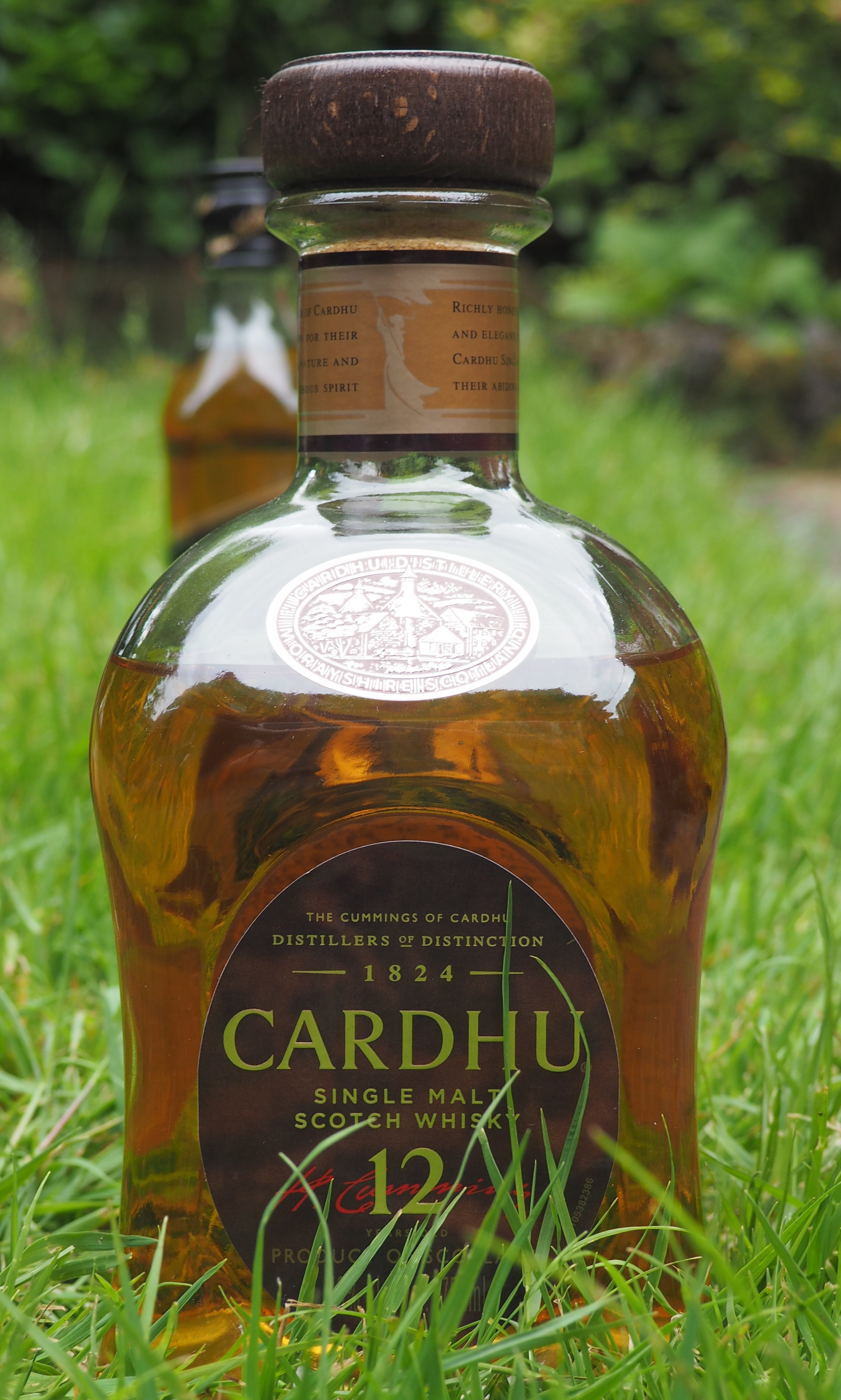
I usually have a bottle of a Speyside or Highland in my rather cramped liquor cabinet for those gentler souls who prefer a whisky that’s milder than my usual suspects—all Island malts. I’ve always been a guy who liked BBQ, spicy Thai and Szechuan, hoppy beers–you get the idea. I go for big taste. So when I started engaging with whisky, I blew quickly through the Glenlivet and Glenfiddich 12-year offerings. They did not exactly turn on my taste buds, and for the cost ($50-ish a bottle where I live), that just was not going to cut it. My buds gravitated to the bigger, smokier and peatier tastes of the Island malts.

Cardhu - you can imagine a lush grassy field when tasting this whisky.
Cardhu – you can imagine a lush grassy field when tasting this whisky.

However, I recognize quality and consider The Macallan 12 a benchmark for well-made whisky. That’s a Speysider I keep around for guests who recoil at my Laphroaig and Ardbeg. When I’m in a calm mood I like a dram of the Mac and when I received a bottle of the Cardhu as a birthday gift this year, I was well impressed. This is crass of me to admit, but being a bit obsessed with cataloging my experiences, I checked out the price. About $42 locally, vs. mid $50 range for Macallan. A nice surprise.


Continue reading “Whisky and Words Number 10: Cardhu 12”